
Reserve Bank of India (RBI) Governor Sanjay Malhotra on Wednesday said regulations should not create unintended barriers to financial inclusion while emphasising that the impact of regulations on individuals and businesses should be considered.

'Just the amount of work which is there just to become more and more successful in banking. For this to happen you need to have leaders who understand technology.'

The Reserve Bank is working with the government to thrash out a payment settlement solution for Indo-Russian trade, which is hit by the economic sanctions imposed on Moscow after it invaded Ukraine, but asserted that any such solution will be 'sensitive' to the prevailing economic blockade, the central bank said. RBI Governor Shaktikanta Das was quick to add that it is a matter that the government has to deal with first, and as far as the central bank is concerned, obviously, we will not do anything which goes against the sanctions. RBI Deputy Governor T Rabi Sankar said since the Ukraine war has disrupted trade and payments, we are discussing with all stakeholders, and at the same time, we are sensitive to the economic sanctions.

"You can download mobile applications provided by banks on your phones and I want to urge political leaders, teachers, youth to give training to people on mobile banking," Modi said.

As in the past, it is up to the merchants to decide if they will bear the burden of the charge or bill it to the customers. Subhomoy Bhattacharjee reports.

In FY24 alone, 1.34 million fraud cases were reported, amounting to losses of Rs 1,087 crore.

In 2025 alone, at least 50 suicides linked to online gambling losses have been reported across India. According to FIRs, the victims were addicted to betting, largely driven by cricket, rummy and poker.

PB Fintech, the parent of Policybazaar and Paisabazaar, has set a price band of Rs 940-950 apiece for its initial public offering (IPO), which will open on November 1 and close on November 3. The company may be valued at around Rs 44,000 crore, and looking to raise an amount of around Rs 5,826 crore. The IPO comprises a fresh issue of Rs 3,750 crore, along with an offer for sale (OFS) of Rs 1959.72 crore by existing promoters and shareholders.
The Reserve Bank of India on Monday tweaked norms related to acquisition and holding of shares in banks to ensure that their ultimate ownership and control remain well diversified and the major shareholders are 'fit and proper' on a continuing basis. The central bank has issued 'Master Direction - Reserve Bank of India (Acquisition and Holding of Shares or Voting Rights in Banking Companies) Directions, 2023'. "These directions are issued with the intent of ensuring that the ultimate ownership and control of banking companies are well diversified and the major shareholders of banking companies are 'fit and proper' on a continuing basis," it said.

Ashok Vaswani, a banker with more than three-and-half decades experience in building and scaling up businesses across consumer and corporate banking and payments, will be the next managing director (MD) and chief executive officer (CEO) of Kotak Mahindra Bank. Last week, the Reserve Bank of India (RBI) had given its approval to Vaswani's appointment. Vaswani is currently President of Pagaya Technologies, a US-Israeli artificial intelligence (AI) fintech firm, which he joined in June 2022.

The niche banks - small finance and payments banks -have been set up to further the regulator's objective of deepening financial inclusion.

Red Square and VDNKh easily rank among the most striking places I've visited -- both for their historical significance and architectural splendour.
My admiration for Russian culture, vision and ambition grew with every step as I clocked the miles, Nitin Sathe tells us after a visit to Moscow and St Petersburg.

Ask rediffGURU and PF and MF expert Janak Patel your mutual fund and personal finance-related questions.
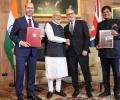
'That way you're not hostage just to US sort of exports to India.'

In an age where personal data is a valuable commodity, investing in cyber insurance is not just a prudent choice; it is becoming a necessity for individuals and families alike, says T A Ramalingam.

An Iranian delegation is expected to visit India this weekend to discuss an arrangement under which Union Bank will make payments to Halk Bank in Turkey.

Review your family emergency fund and replenish it if needed. Revisit financial goals to see if there is any change in timeline or the corpus required.

Each postman has undergone a three-tier training process, after which they were evaluated by the National Institute of Banking and Finance and given certificates.

'LAP is suited for borrowers with a steady income, sound repayment discipline, and a clear repayment plan.'

Facebook-owned messaging platform WhatsApp has been granted permission to double its user base for the payments service to 40 million by the National Payments Corporation of India (NPCI). WhatsApp has a total user base of 400 million and the development will help the platform compete better with entrenched rivals like Google Pay and Phone Pe. The US-based company had been eyeing the payments opportunity for long, but data localisation requirements had initially led to a delay.

The court said there is nothing on record to suggest that since 2023, Purkayastha was ever called to join the investigations.
The liquidity in the banking system moved into surplus almost after three months as the Reserve Bank of India (RBI) absorbed over Rs 40,000 crore from the market on Monday, predominantly on the back of increased government spending. However, this situation may be short-lived given the higher demand for funds to pay taxes and year-end targets, treasury executives said. Meanwhile, two variable reverse repo rate (VRRR) auctions held on Tuesday received weak response.

'This helps the consumers secure more favourable terms from CIs.'

The government is likely to introduce a bill seeking amendments to the Insurance Act, 1938, during the upcoming Budget session to achieve 'Insurance for All by 2047'. Some of the provisions, which could be part of the amendment bill, include composite license, differential capital, reduction in solvency norms, issuing captive license, change in investment regulations, one-time registration for intermediaries and allowing insurers to distribute other financial products, sources said.
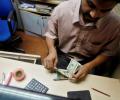
Upcoming payment banks will lift lower income groups in distant villages.

While some are relatively new in this business, Vodafone, which has 1.8 million touch points in the country, has been offering basic banking and payment services through its pre-paid mobile digital semi-closed wallet called M-Pesa since 2012.

The small finance bank model may still be testing the water some 10 years since its launch. According to banking experts, the regulator has taken a cautious approach in granting approvals. Unity Small Finance Bank was the last one to get a licence in the category in November 2021.

'We are also conducting ongoing training and grooming at the branch level to pre-empt such cyberattacks.'

Ask rediffGURU and PF and MF expert Janak Patel your mutual fund and personal finance-related questions.

The Union finance ministry will meet CEOs of public sector banks to discuss issues related to cybersecurity in the wake of the Rs 820 crore (Rs 8.2 billion) fraud that hit Kolkata-based UCO Bank last month.

Fintech firm BharatPe is targeting an initial public offering (IPO) in the next 18-24 months with the company expecting profitability at an earnings before interest, taxes, depreciation and ammotisation (Ebitda) level for FY25, chief executive officer (CEO) Nalin Negi said.

To enable Indian banks and financial institutions to develop an aircraft-leasing ecosystem at GIFT City, the Ministry of Civil Aviation has sought support from the Ministry of Finance. It has also raised concern over slow progress in developing aircraft leasing in India.

MCA blamed its financial troubles on non-receipt of payments from the Board of Control for Cricket in India for the last 10 months.

The country has come a long way in the process of financial inclusion, Raghuram Rajan said, but "still has a way to go".

rediffGURU T S Khurana answers readers' personal income tax queries.

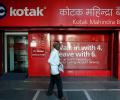
Cracking down on repeated non-compliance of IT norms, the RBI on Wednesday barred Kotak Mahindra Bank from onboarding new customers through its online and mobile banking channels and issuing fresh credit cards with immediate effect after the regulator found "serious deficiencies" in the lender's IT risk management. These actions, the RBI said, are necessitated based on significant concerns arising out of Reserve Bank's IT examination of the bank for the years 2022 and 2023 and the continued failure on part of the bank to address these concerns in a comprehensive and timely manner.

In 2024, the National Payments Corporation of India (NPCI) approved 20 third-party Unified Payments Interface (UPI) applications, a record since UPI's launch in 2016. This surge reflects growing interest from financial technology (fintech) companies, driven by the integration of credit products like UPI-linked credit cards and pre-approved credit lines.

In response to the panic triggered by Trump's trade policies, the RBI net sold approximately $43 billion in the second half of FY25 to curb volatility, as the rupee plunged to a low of 87.95 per dollar in February this year.

Targets should avoid panicking and hang up. 'Disconnecting stops the scammers from building psychological pressure.'
